
Promo code vs coupon code – are they the same thing, or is there actually a difference? And where do terms like “deal”, “sale”, “voucher”, and “discount” fit in? If you have ever been confused by the terminology on shopping and deals websites, you are not alone.
The short answer is that promo codes and coupon codes are functionally the same thing in most situations. But the broader vocabulary of online discounts – deals, sales, clearance, vouchers – does carry real distinctions that are worth understanding. Knowing the difference helps you pick the right type of offer for any purchase and avoid the confusion that leads to missed savings.
This guide breaks down every term clearly, once and for all.
Promo code vs coupon code – is there actually a difference?
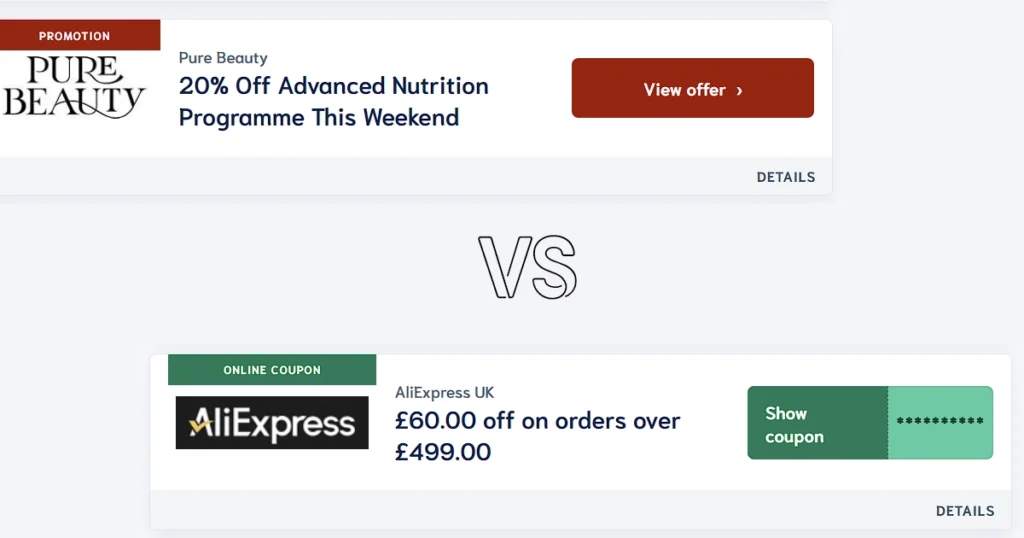
In everyday use, promo code and coupon code are interchangeable. But here is what matters more in 2026: for most shoppers, the distinction between a “code you enter manually” and an “automatic deal” has become irrelevant anyway.
Modern deals platforms have changed how discounts work in practice. When you click or tap any offer on MyBestDealsMarket, the discount is applied automatically through the redirect link – you land on the retailer’s page with the saving already attached. No code to copy, no field to find at checkout, no risk of typing it wrong.
What used to require three steps – find the code, copy it, paste it at checkout – now requires one: click the offer and shop as normal.
This means the technical difference between a promo code, a coupon code, and an automatic deal has largely collapsed from the shopper’s perspective. You click, you save. Whether the underlying mechanism is a code-based discount or an automatic promotion is something the platform handles invisibly in the background.
The terminology still appears on retailer websites and in email newsletters where codes are distributed directly. But on a modern deals platform the experience is the same regardless of the offer type.
The verdict: in current online shopping, promo code = coupon code = deal. One click handles all of them.
What is a “deal” – and how is it different?
A deal is a broader term that covers any situation where a product or service is available at a reduced price or better-than-usual value. Unlike a promo code or coupon code, a deal does not necessarily require entering a code at checkout.
Deals include:
Automatic discounts – the reduced price is applied to all customers without any action required. You add the item to your basket and the discount is already reflected in the price shown.
Bundle offers – buy two items and receive a third free, or get a discount when purchasing a set of products together.
Loyalty rewards – discounts applied automatically when you are logged in to a retailer’s account, based on your purchase history or membership tier.
Flash sales – time-limited price reductions on specific products, available to all shoppers without a code.
The key distinction is that a deal is often passive – the saving comes to you automatically – while a coupon or promo code requires a deliberate action on your part. Both are worth looking for before any purchase. MyBestDealsMarket lists both types in one place, so you can see at a glance whether a code or an automatic deal is available for any store.
What is a “sale” – and how does it differ from a deal?
A sale is a scheduled event during which a retailer reduces prices across a range of products, usually for a defined period. Sales are time-limited by nature and typically affect a broader selection of items than a single deal.
Common types of sales include:
Seasonal sales – end-of-season clearances where retailers reduce prices on outgoing stock to make room for new inventory. Summer and winter sales are the most common examples.
Event-driven sales – promotions tied to specific calendar events such as Black Friday, Cyber Monday, Back to School, or Valentine’s Day. These are planned well in advance and often represent the deepest discounts of the year on certain product categories.
Clearance sales – reductions on items being permanently discontinued or removed from a retailer’s range. Prices in clearance sections are often the lowest available, though selection is limited.
The practical difference between a sale and a deal is scope and timing. A deal might be available on a single product any time of year. A sale is a broader event with a start and end date. The smartest approach is to combine both – check whether a promo or coupon code can be applied on top of an already-reduced sale price, as many retailers allow this.
What is a “voucher code” – same as a coupon?
Yes. Voucher code is simply the British English term for what American English speakers call a coupon code, and what most international retailers call a promo code. All three terms describe the same thing: a code you enter at checkout to receive a discount.
You will see “voucher code” used most commonly on UK-based retail sites and deals platforms. If you are shopping internationally, the same code might be described differently depending on the retailer’s regional terminology. The function is identical regardless of the label.
The 4 key terms – a clear summary
Here is a plain-English breakdown of all four terms side by side:
Coupon code / Promo code / Voucher code A code you enter at checkout. Reduces your total by a percentage, a fixed amount, or removes shipping costs. Requires a deliberate action to apply. All three terms mean the same thing.
Deal A reduced price or added value offer that may or may not require a code. Can be automatic, bundle-based, or loyalty-linked. Broader than a coupon code.
Sale A time-limited event during which a retailer reduces prices across multiple products. No code usually required – the lower prices are visible to all shoppers during the sale period.
Clearance The deepest category of discount, applied to items being permanently removed from sale. Limited selection, but often the lowest prices available from a retailer.
According to Statista, online discount usage has grown consistently year on year, with more shoppers actively seeking reduced prices before completing purchases. Understanding which type of discount applies to your situation helps you find the right saving faster.
How to use this knowledge when shopping
In practice, knowing these distinctions changes how you approach any purchase:
Before buying at full price – check whether a promo or coupon code exists for that store. This takes under a minute on a deals platform. If a code is available, apply it before checkout regardless of whether the item is already on sale.
During a sale event – check whether a coupon code can be stacked on top of the sale price. Many retailers permit this, particularly on orders that meet a minimum spend threshold.
When browsing deals – understand whether you are looking at an automatic deal or a code-based one. Automatic deals require no action. Code-based offers require you to copy or click the code before visiting the store.
For the deepest discounts – clearance sections combined with a coupon code represent the lowest price most retailers will offer. If timing is flexible, waiting for a clearance event on a product you want is a legitimate strategy.
Browse all current promo codes, deals, and sale events across 12 shopping categories at MyBestDealsMarket – updated regularly, no account needed.
Frequently asked questions
Can I use a coupon code during a sale? In many cases yes – retailers often allow a promo code to be applied on top of already-reduced sale prices. The easiest way to find out is to try applying the code at checkout. If the total reduces further, the combination is permitted.
What happens if my promo code does not work during a sale? Some retailers exclude sale items from coupon code discounts. This is usually stated in the terms of the promotion. If a code does not apply to sale items, look for an automatic deal or a free shipping code instead.
Is a voucher different from a gift card? Yes. A voucher code is a promotional discount issued by a brand to reduce the price of a purchase. A gift card is a prepaid balance that you or someone else has already paid for. They work differently at checkout – a voucher reduces the price, a gift card spends a pre-loaded balance.
Do deals expire the same way coupon codes do? Automatic deals and sale events have defined end dates set by the retailer. Code-based discounts have their own separate expiry dates. Both types are time-limited – checking a deals site before purchasing ensures you are seeing only current, active offers.
The bottom line
Promo code, coupon code, voucher code – same thing, different names. A deal is broader and often automatic. A sale is a time-limited event. Clearance is the deepest discount tier.
The terminology matters less than the habit: before any online purchase, spend 60 seconds checking MyBestDealsMarket for whatever type of saving is currently available for that store. Code, deal, or sale – the result is the same. You pay less.
Discount availability and offer types vary by retailer and change frequently. Always confirm the final price at checkout on the retailer’s website before completing your purchase.